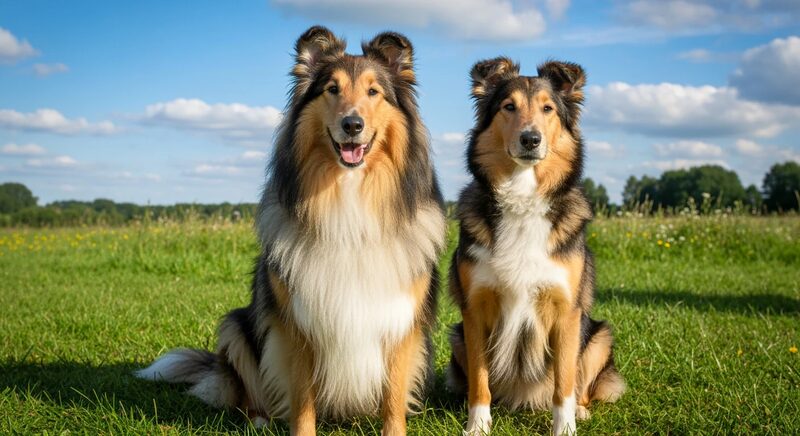
Coat colour gets most of the attention, but coat texture is where breeders are most often caught out. A litter of Border Collies can hold both long, profuse coats and sleek short ones; Rough and Smooth Collies are the same breed wearing two completely different jackets. None of this is random. Coat length, furnishings, and curl are governed by a small number of genes with clean, predictable inheritance — which means that, unlike many traits, you can forecast the coats in a litter from the parents’ genotypes. This is the texture-and-length counterpart to our look at coat colour genetics; the genes involved are entirely separate, so they sort independently.
FGF5: The Long-vs-Short Switch
The master gene for coat length is FGF5 (Fibroblast Growth Factor 5). FGF5 controls how long each hair grows before the follicle stops it and the hair is shed. Functional FGF5 cuts the growth phase short, producing a short coat. A loss-of-function mutation in FGF5 lets the growth phase run longer, producing a long coat.
The long-coat variant is recessive. Using uppercase for the short-coat (functional) allele and lowercase for the long-coat variant:
- L/L — short coat, carries nothing long
- L/l — short coat, but a carrier of long
- l/l — long coat
This single gene is what separates Smooth Collies (short) from Rough Collies (long), and what produces the occasional long-coated Border Collie or “long-haired” individual in breeds expected to be short. Because the long variant is recessive and invisible in carriers, two short-coated dogs that are both L/l can — and on average one puppy in four will — produce long-coated puppies. That surprises owners who assumed two short coats could only make short coats.
RSPO2: The Furnishings Gene
Length is only half the story of texture. The other half is furnishings — the eyebrows, moustache, and beard that give some dogs a bushy, “scruffy” face and others a clean, smooth muzzle. Furnishings are controlled by a separate gene, RSPO2 (R-spondin 2).
Here the relationship flips: the variant that adds furnishings is dominant. A single copy is enough to give a dog the eyebrows-and-beard look; a dog with two non-furnished copies has a smooth, clean face. This is why furnishings can appear in a litter even when only one parent shows them, and why they behave so differently from coat length in the maths of a mating.
In herding breeds, RSPO2 explains a lot of the “look” variation that owners notice but cannot name. The interplay of FGF5 and RSPO2 produces the recognised coat types in many breeds — short and smooth-faced, short with furnishings, long and smooth-faced, long with furnishings — from just two independently inherited genes.
KRT71: Adding Curl
A third gene fine-tunes texture: KRT71 (Keratin 71), which influences whether the coat is straight, wavy, or curly. Variants in KRT71 push the coat toward curl; combined with the long-coat FGF5 variant and furnishings from RSPO2, KRT71 helps explain the wavy and curly coats seen across various breeds.
In most working herding lines KRT71 is less of a day-to-day concern than FGF5 and RSPO2, simply because curl is not a common feature of Border Collie or Collie coats. But it completes the picture: length (FGF5) + furnishings (RSPO2) + curl (KRT71) is the three-gene framework that accounts for the great majority of coat-texture variation, and the commercial coat panels you can buy test exactly these three loci.
Predicting Coat Type in a Litter
The real practical value of this knowledge is prediction. Because each gene follows simple Mendelian rules, you can work out the coat possibilities of a litter before mating — and a DNA panel removes the guesswork about carriers.
Take coat length. If you understand each parent’s FGF5 genotype, the outcomes are fixed:
- L/L × L/L → 100% short, no long carriers produced.
- L/L × l/l → 100% short, but every puppy is an L/l carrier of long.
- L/l × L/l → on average 25% long-coated (l/l), 50% short carriers, 25% short non-carriers.
- l/l × l/l → 100% long-coated.
Furnishings work the same way, but with dominance reversed: pair two non-furnished dogs and you cannot get furnishings; introduce one furnished parent carrying a single copy and roughly half the litter will be furnished.
The reason this matters: a short-coated dog tells you nothing, by sight, about whether it carries long. Two beautiful smooth coats can quietly both be L/l and routinely throw long-coated puppies. If coat type matters for your breed standard or your buyers, a coat-length DNA test on breeding stock is cheap and ends the surprises. It is the same logic we apply across rough and smooth Collie health and type — know the genotype, and the phenotype of the next generation stops being a lottery.
Texture Is Cosmetic — but Worth Getting Right
It is worth keeping perspective. Unlike the inherited diseases that dominate herding-breed genetics, coat length, furnishings, and curl are cosmetic traits. A long-coated Border Collie is not a defective one; it is a perfectly healthy dog wearing a different coat, and in some breeds (the Rough Collie) the long coat is the standard. None of these variants carries a health penalty in the way that, say, the merle dilution can when doubled.
That said, getting coat genetics right serves three real purposes: meeting a breed standard where coat type is judged, setting honest expectations for puppy buyers, and avoiding the small dramas of an unexpected long-coated litter from two short-coated parents. With three well-understood genes and an inexpensive panel, coat type is one of the few things in dog breeding you can genuinely predict in advance — so there is little excuse for being caught out by it.