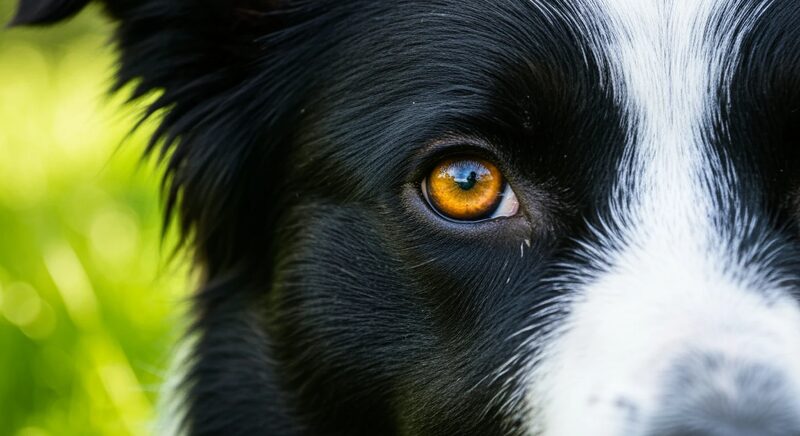
Of all the inherited eye conditions in herding breeds, goniodysgenesis-related glaucoma is the most deceptive. A dog can pass eye exams for years, see perfectly, show no outward sign of trouble — and then lose the sight in one eye over a single weekend, in real pain, before the owner has fully understood what is happening. Understanding the mechanism, and why a reassuring DNA result is not a clean bill of health, is the best protection a breeder or owner has.
How the Eye Drains — and How It Fails
The eye is not a sealed bag of fluid. It continuously produces a watery fluid called aqueous humour, which nourishes the front of the eye and then drains away to keep internal pressure stable. That drainage happens through a fine mesh of tissue at the iridocorneal angle — the junction where the iris meets the cornea, around the rim of the eye.
In goniodysgenesis, that drainage angle is malformed from birth. Instead of an open, well-structured mesh, the dog has abnormal sheets of tissue (sometimes called pectinate ligament dysplasia) that partly block the outflow. For a long time the eye copes: it drains slowly but adequately, and pressure stays normal. The defect is structural and silent.
The danger is that this poorly drained eye has no reserve. If outflow drops further, fluid backs up, and intraocular pressure rises — sometimes suddenly and steeply. The result is primary glaucoma: a painful, rapidly damaging spike in pressure that crushes the retina and optic nerve. Vision can be lost within hours to days, and once the optic nerve is destroyed it does not recover. Acute glaucoma is a genuine emergency; a red, cloudy, painful eye with a dilated pupil in a predisposed breed needs a vet the same day, not next week.
A Different Problem from CEA and PRA
It is worth being precise here, because herding breeds carry several inherited eye diseases and they are easy to confuse. This is not collie eye anomaly, which is a developmental fault in the back of the eye (the choroid and related structures) present from birth and largely non-progressive. Nor is it progressive retinal atrophy, the gradual, painless degeneration of the photoreceptors that ends in slow blindness.
Goniodysgenesis sits in a different category: a structural defect at the front of the eye that creates the risk of a sudden, pressure-driven, painful event later in life. The blindness, when it comes, is fast and acute rather than slow and silent. Lumping all three together under “eye problems” hides exactly the distinctions that determine how you screen and what you watch for.
Why a DNA Result Is a Risk Marker, Not a Diagnosis
Genetics has given us partial tools here. Research in Border Collies and some other breeds has identified DNA markers associated with goniodysgenesis and elevated glaucoma risk, and commercial panels now report a “risk” status. This is genuinely useful — but it must be read correctly, and this is where owners most often go wrong.
A “high-risk” DNA result is a predisposition, not a diagnosis. It tells you the dog is more likely than average to have a malformed angle and to develop glaucoma. It does not tell you the dog will, nor when, nor in which eye. The inheritance behaves as a complex, autosomal-recessive-with-modifiers pattern: the identified variant raises risk, but additional genes and unknown factors decide whether, and how severely, the disease actually manifests. Penetrance is incomplete.
The flip side matters just as much: a “low-risk” result does not guarantee a normal eye. The known markers explain only part of the genetic story, so a dog can score reassuringly on the panel and still have a malformed drainage angle. Treating a low-risk DNA result as a clean bill of ocular health is the single most dangerous misreading of these tests. If you want a fuller picture of what genetic panels can and cannot promise in general, our DNA testing guide is a good companion read.
The Gene-Plus-Clinical-Screening Model
Because DNA alone cannot confirm or exclude the structural defect, goniodysgenesis is the textbook case for combining genetic risk with a hands-on clinical exam. That clinical test is gonioscopy: an ophthalmologist places a special lens on the surface of the eye to look directly at the drainage angle and grade how open or obstructed it is.
The two tools answer different questions and belong together:
- The DNA test estimates inherited risk and helps plan matings — keeping high-risk dogs from being doubled up, and tracking risk across a line over generations.
- Gonioscopy examines the actual anatomy of this dog’s eye, today. It can catch a malformed angle that the genetic markers missed, and it is the basis for official eye-scheme grading in many countries.
A sensible protocol uses genetic results to stratify risk and inform breeding decisions, while relying on periodic specialist eye examinations — including gonioscopy and pressure checks — to monitor the individual dog. Because the drainage angle can change with age, a single normal gonioscopy in a young dog is not a lifetime guarantee either; repeat screening is recommended for breeding animals.
What to Do With This
For breeders: test for the known risk variant, avoid pairing two high-risk dogs, and insist on gonioscopy and eye-scheme grading for breeding stock — do not let a low-risk DNA panel substitute for a real eye exam. For owners of any predisposed dog: know the emergency signs of acute glaucoma (a suddenly painful, red, cloudy eye with a fixed, dilated pupil and obvious discomfort) and treat them as an immediate veterinary emergency. Pressure caught and lowered within hours can sometimes save sight; pressure left for days almost never does.
The hidden nature of this disease is precisely what makes that combined vigilance worthwhile. The eye gives little warning before it fails — so the screening has to do the warning for it.