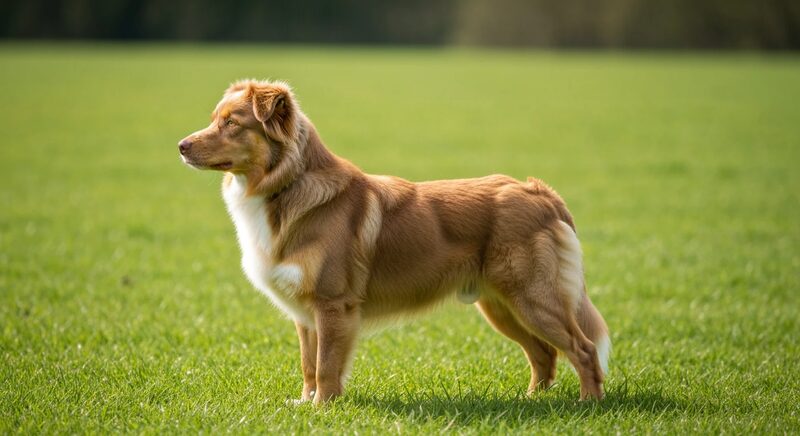
A naturally short tail is one of the signatures of several herding breeds — the Australian Shepherd, the Pembroke Welsh Corgi, the Brittany, the Schipperke. It looks like a simple cosmetic quirk. It is not. The natural bobtail is caused by a single dominant mutation that is also semi-lethal: dogs that inherit two copies die before birth. That one fact dictates how the trait can be bred responsibly, explains why you almost never see certain matings, and sits at the centre of a genuine welfare debate about whether breeding for a bobtail is kinder or crueller than docking. Here is what the genetics actually say.
The C189G mutation in TBXT
The natural bobtail is caused by a mutation called C189G in the TBXT gene — historically known as the T gene, and the gene whose protein, brachyury, helps direct the formation of the spine and tail during embryonic development. The mutation changes a single DNA letter, swapping one amino acid in the brachyury protein, and that change shortens the tail.
A few important features of this mutation:
- It is dominant, so a single copy produces a visibly bobbed tail. A bobtail dog has at least one copy of the mutation.
- It is variable in effect: tail length in bobtail dogs ranges from nearly absent to a half-length tail, even among littermates with the same genotype.
- It is the same mutation across many breeds, indicating an ancient origin that predates the modern breeds carrying it.
In Australian Shepherds, the bobtail allele is common — roughly one in five dogs carries it. Because the trait is so tied to breed identity and was historically favoured, the mutation has been deliberately maintained in many lines.
Why “semi-lethal” changes everything
The decisive fact about TBXT is what happens with two copies of the mutation. The bobtail allele is homozygous lethal: an embryo that inherits the mutation from both parents fails to develop a normal spine and dies in the womb, typically reabsorbed early in pregnancy. This is why the trait is described as a dominant semi-lethal — dominant in its visible single-copy effect, lethal in its double-copy state.
That biology forces the breeding math. Consider the two possible matings that involve bobtails:
- Bobtail × Full-tail (heterozygous bobtail bred to a normal-tailed dog): on average half the puppies are bobtail and half full-tailed. No embryos are lost to the mutation. This is the safe, standard cross.
- Bobtail × Bobtail (two heterozygotes): the classic dominant ratio would predict 1 lethal : 2 bobtail : 1 full-tail. The double-copy quarter dies before birth, so the surviving litter is smaller by about a quarter, and the live puppies are two-thirds bobtail, one-third full-tail.
In other words, mating two bobtails together does not produce “extra-bobtailed” puppies — it produces fewer puppies, because a quarter of the conceptions are lost. There is no genetic benefit and a clear cost.
The other risks: spine, anus, and urinary tract
The lethality of the homozygous state is the headline, but the TBXT mutation can carry consequences even in single-copy bobtail dogs. Because brachyury governs the development of the lower spine and the structures around it, bobtail dogs have a somewhat higher reported incidence of spinal and related defects, including:
- vertebral malformations and a shortened or kinked lower spine,
- spina bifida and other neural-tube defects in the sacral region,
- occasional anal and urinary tract abnormalities tied to the same developmental zone.
These are not common in every bobtail dog, and many live entirely normal lives. But the association is real and is part of why the trait deserves to be managed thoughtfully rather than maximised. It is a reminder that a genetics shortcut to a desired look can ripple into structures the gene also helps build.
The breeding rule — and the ethics debate
From the genetics, the responsible breeding rule writes itself: always pair a bobtail with a full-tailed dog. This avoids the embryonic loss of bobtail × bobtail matings entirely, keeps litter sizes normal, and still produces roughly half bobtail puppies for breeders who want the trait. There is simply no sound reason to mate two bobtails together. Maintaining full-tailed dogs in the gene pool also protects against the temptation to fix the allele, which the lethal homozygote makes impossible anyway.
This is where the natural bobtail meets a broader breeding ethics question. In many countries, surgical tail docking of puppies has been banned or heavily restricted on welfare grounds. For breeds traditionally shown with a short tail, the natural bobtail gene offers an apparent alternative: a short tail without a surgical procedure on a newborn puppy. To some breeders that is the more humane path — no docking, no cutting.
But the genetics complicate the “more natural is kinder” intuition. Breeding for the bobtail means knowingly carrying a semi-lethal allele that costs embryos and is associated with spinal defects. Critics argue this trades the welfare cost of a brief surgical procedure for a deeper genetic one written into development itself. There is no clean answer, and the honest position is that both routes to a short tail carry welfare considerations — one surgical and visible, one genetic and hidden.
What is not in dispute is the practical handling. A breeder working with bobtail lines should know each breeding dog’s status, never mate two bobtails, keep full-tailed dogs central to the programme, and be candid with puppy buyers about the trait and its associations. Handled that way, the natural bobtail is a manageable piece of breed heritage. Handled carelessly — by chasing bobtail-to-bobtail litters — it quietly wastes puppies and raises risk for no gain at all.