Why Population Genetics Matters for Herding Breeds
When breeders talk about linebreeding, popular sires, and outcrossing, they are using practical language that encodes the same concepts that population geneticists formalize mathematically. The tools of population genetics — allele frequencies, drift, effective population size, Hardy-Weinberg equilibrium — are not abstract theoretical constructs. They describe the forces that have shaped every herding breed currently registered in a studbook, and they will shape those breeds for generations to come.
Understanding even the basic principles of population genetics helps breeders make decisions grounded in biological reality rather than tradition alone. This article provides an accessible introduction to the key concepts and their direct application to herding breed management.
Allele Frequencies and How They Change
At its most fundamental level, a breed’s genetic state at any locus can be described by the frequencies of the alleles present in the population. For a simple two-allele locus, if 30% of the alleles in the population are the “A” allele and 70% are the “a” allele, then 0.30 and 0.70 are the respective allele frequencies.
These frequencies change over time through several mechanisms:
Natural selection alters frequencies by differentially affecting the survival and reproduction of individuals carrying different alleles. In domesticated animals under human management, artificial selection substitutes for or supplements natural selection.
Genetic drift is random change in allele frequency due to the sampling process of reproduction. In a small population, chance plays a larger role in which alleles are passed to the next generation. A rare allele might be lost entirely — not because it is disadvantageous, but simply because by chance none of its carriers happened to reproduce in a given generation.
Gene flow introduces new alleles into a population through immigration from other populations. In closed-registry breeds, gene flow is by definition absent or severely restricted.
Mutation introduces genuinely new alleles, but the rate is low enough that mutation is negligible on the timescales relevant to domestic breed management.
For closed herding breed populations, drift and selection are the dominant forces, with no gene flow from outside the studbook.
The Founder Effect in Herding Breeds
Most purebred herding breeds were established by drawing a small number of founding individuals from a broader population, then closing the studbook. This founding event imposed an immediate, dramatic reduction in the genetic diversity available to the breed.
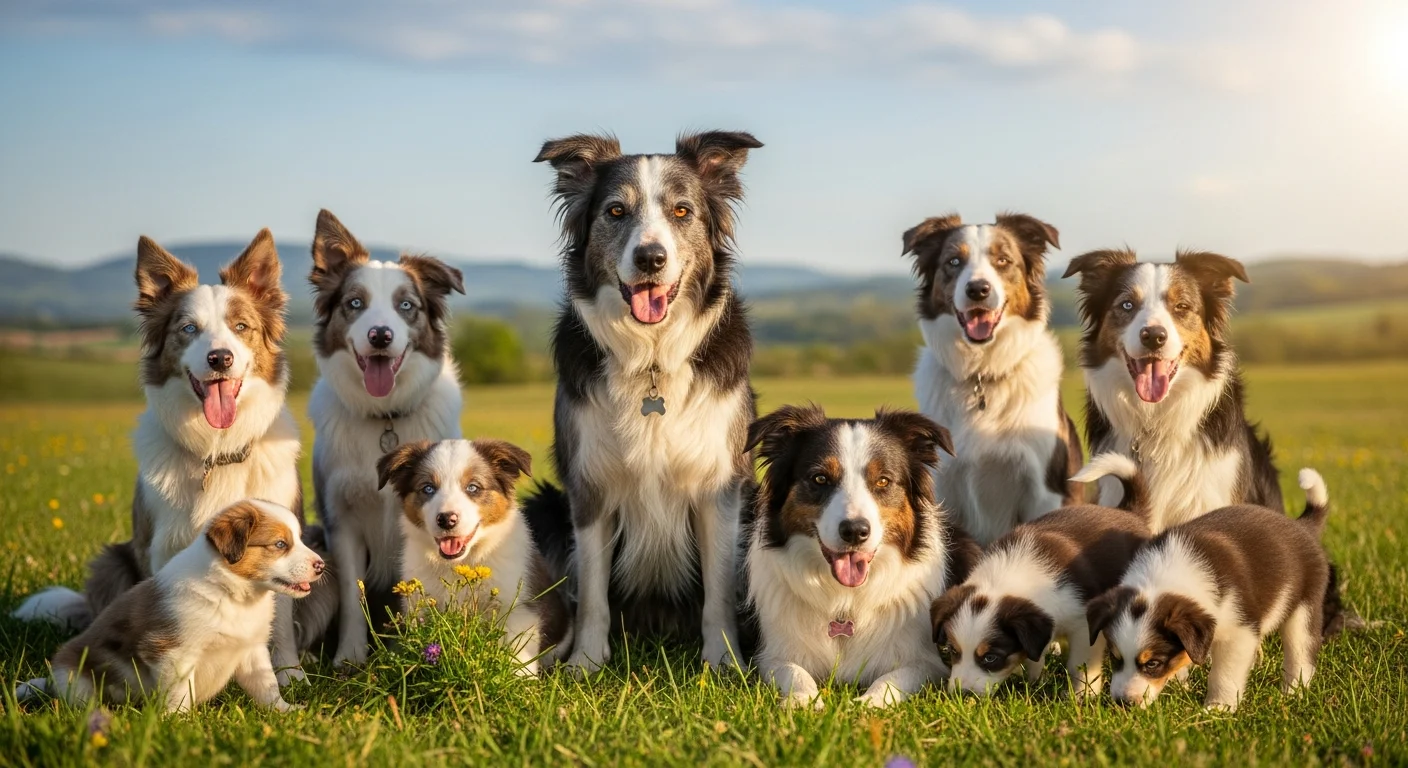
The founder effect has two consequences. First, it reduces total genetic diversity relative to the source population — alleles present at low frequency in the founding individuals may have been absent by chance, and the variance of allele frequencies is higher in small samples. Second, the genetic characteristics of the founding individuals, including any disease alleles they happened to carry, are transmitted to all subsequent generations.
The degree of founder representation in modern breeds varies considerably. In some breeds, genomic analysis has identified as few as a handful of individuals who account for a majority of the genetic diversity in contemporary populations. A founding dog that contributed heavily to the early gene pool — perhaps because it was exceptional in working ability, had many litters, or happened to be used by multiple early breeders — may have its genetic fingerprints visible in essentially every dog registered in the breed today.
This is directly connected to the genetic bottleneck dynamics that have shaped specific herding breeds, including the dramatic impacts seen in Border Collies, Australian Shepherds, and German Shepherds. Understanding the founder effect helps explain why disease alleles can be so prevalent in breeds despite selective breeding: if the founding individuals happened to carry those alleles, their descendants will, too.
Effective Population Size: The Number That Matters
The effective population size (Ne) is arguably the most important single number in population genetics, and it is almost always smaller — sometimes dramatically smaller — than the census population size (the actual number of registered dogs).
Ne measures the size of an idealized population that would show the same rate of genetic drift as the real population. It depends not just on how many dogs exist but on:
The sex ratio of breeding animals. In a breed where a small number of popular studs serve many females, the effective contribution of males is concentrated, reducing Ne. The formula for unequal sex ratios is Ne ≈ 4 × Nm × Nf / (Nm + Nf), where Nm and Nf are the numbers of breeding males and females. If ten males breed with a thousand females, Ne is approximately 40, not 1,010.
Variance in family size. If some animals contribute many offspring and others none, the effective size is reduced below what an equal contribution would give. The classic “popular sire” problem in dogs is a direct manifestation of this: a single champion stud with hundreds of offspring contributes to enormously increased kinship across the breed in subsequent generations.
Fluctuations in population size. Population bottlenecks, even brief ones, have lasting effects on genetic diversity. The effective size over time behaves like the harmonic mean of the sizes in each generation, meaning that a single generation of very small size (perhaps during a world war, when breeding programs were interrupted) can dramatically reduce effective diversity even if the census population recovers.
Published Ne estimates for many herding breeds are sobering. Studies using genomic data have estimated Ne values in the range of 50-200 for several popular herding breeds, despite census populations in the tens or hundreds of thousands. These low Ne values explain why genetic diversity erodes, why inbreeding coefficients rise, and why disease alleles spread.
Hardy-Weinberg Equilibrium and Detecting Deviations
In an idealized large, random-mating population with no selection, mutation, or drift, allele frequencies remain constant from generation to generation, and genotype frequencies follow predictable ratios determined by allele frequencies alone. This is Hardy-Weinberg equilibrium (HWE). For a locus with alleles A (frequency p) and a (frequency q = 1-p), the expected genotype frequencies are p² (AA), 2pq (Aa), and q² (aa).
Real dog breeding populations deviate from HWE in systematic ways. The most important deviation for breeders is excess homozygosity — more AA and aa individuals, fewer Aa individuals, than HWE predicts. This pattern, called inbreeding excess or F-statistics deviation, arises when dogs are preferentially bred to relatives, which is nearly universal in closed-registry breeding.
When a laboratory tests a large sample of dogs for a disease locus and finds that carriers (Aa) are less common than expected from HWE, this can indicate either inbreeding or artificial selection against carriers by breeders who are testing and avoiding carrier-carrier matings. Both interpretations are meaningful for understanding population health.
The Popular Sire Effect and Its Long Shadow
No discussion of herding breed population genetics would be complete without addressing the popular sire problem, which is arguably the single most damaging practice to breed genetic diversity in the twentieth century of purebred dog breeding.
A stud dog that achieves remarkable competitive success — champion titles, working trial victories, an excellent health record — attracts demand from breeders across a country or internationally. If that dog sires five hundred puppies rather than the ten to twenty that would be expected in a natural population, his genetic contribution to the next generation is proportionally enormous.
The immediate consequences are visible: kinship increases across the breed as a whole, the effective population size collapses, and any alleles the popular sire happens to carry — including any he happens to carry for disease conditions — are suddenly at elevated frequency across the breed. Breeders using the dog’s sons and daughters in subsequent generations may inadvertently be pairing cousins, half-siblings, or individuals even more closely related without realizing it from standard pedigree inspection alone.
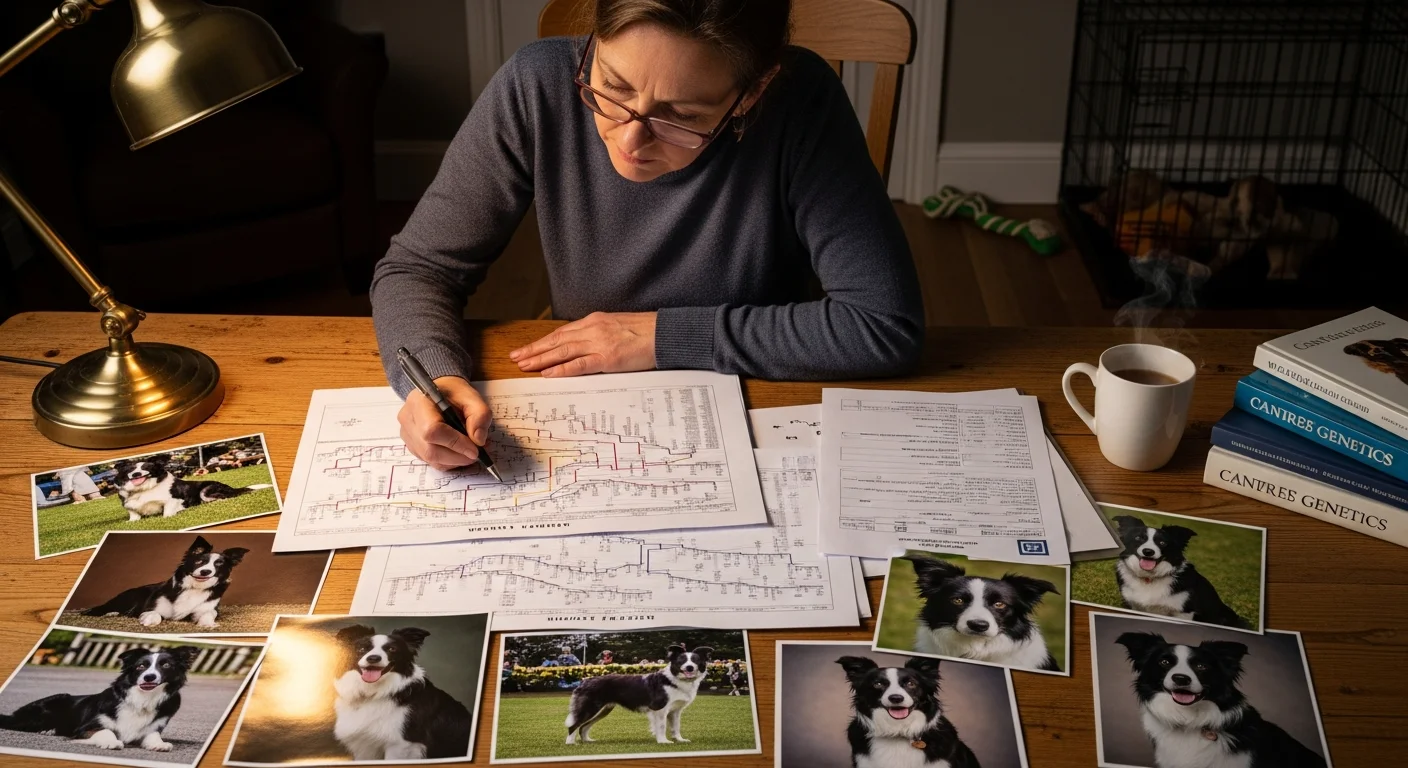
The genomic tools now available can quantify exactly how much of a breed’s contemporary genetic diversity traces back to individual ancestors. In several herding breeds, a single male ancestor from the mid-twentieth century can be identified as contributing more than 50% of the genetic material in the current registered population. This is not a tribute to that dog’s quality; it is an indictment of a breeding structure that permitted such extreme concentration.
The solution is not to avoid using excellent dogs but to limit the number of litters any single dog sires, to actively seek pairings that minimize kinship, and to recognize that contribution to future generations is a responsibility to be distributed across the breeding population rather than concentrated in the most visible individuals.
Admixture and the Question of Breed Purity
Population genetic analysis of domestic dog breeds has revealed that virtually all breeds carry some degree of admixture from other breeds or from village dog populations, reflecting their historical origins. What we now call distinct breeds represent relatively recent definitions of boundaries that were not always clearly enforced during the formative periods of breed development.
For herding breeds specifically, genomic studies have shown close relationships between certain breeds that breeders and historians have long observed from functional and morphological similarity. The genetic clustering of Border Collies, Kelpies, and other Australian working breeds reflects their shared origins in the British Isles. The herding breed cluster also shows some genomic proximity to livestock guardian breeds, consistent with historical accounts of both types being developed in similar pastoral contexts.
This admixture history has practical implications. Heterosis, or hybrid vigor, is a well-established biological phenomenon where F1 offspring of divergent parental strains show enhanced fitness relative to either parental line. While breeds are not strains in the same sense as inbred laboratory lines, the principle suggests that genetic diversity introduced from sufficiently divergent sources may confer health benefits. This is one rationale, alongside behavioral and working considerations, for controlled outcrossing programs in breeds with severely reduced Ne.
Genomic Tools for Population Monitoring
The growing availability of high-density SNP genotyping at accessible cost has made it possible to monitor population genetic parameters in real time. Breed health committees and research collaborators can now:
Map runs of homozygosity (ROH) across the genome to identify regions under selection, recent common ancestors, and the distribution of inbreeding levels across the breed population.
Calculate genomic kinship matrices that reveal relationships among all sequenced individuals, flagging unexpectedly close relatives and identifying the most and least related available breeding animals.
Track allele frequency changes across generations, identifying loci where frequencies are shifting rapidly (suggesting selection, intentional or unintentional) or where diversity is being lost (suggesting drift in small populations).
Estimate effective population size more accurately than pedigree-based methods allow, using linkage disequilibrium patterns that directly reflect historical effective size.
These tools are increasingly being used by progressive breed health initiatives globally. For individual breeders, the most immediately accessible application is genomic COI calculation and kinship-informed mate selection, both of which are now offered by commercial testing services. Pairing this genetic data with the comprehensive DNA testing programs that screen for specific disease alleles gives breeders the most complete genetic picture available.
The application of population genetic thinking to herding breed management is not a replacement for the empirical wisdom accumulated by generations of working dog breeders. It is a supplement — a set of quantitative tools that make the biological consequences of breeding choices visible and measurable, supporting more informed decisions for the breeds we are responsible for stewarding.