Understanding Degenerative Myelopathy and the SOD1 Gene
Degenerative myelopathy (DM) is among the most heartbreaking conditions that herding breed owners face. A progressive, incurable neurological disease of the spinal cord, DM gradually robs affected dogs of their mobility, transforming active working dogs into paralyzed patients over a period of months to years. At the center of this disease lies a mutation in the SOD1 gene, a variant whose biology connects canine medicine to one of the most intensively studied human neurological diseases: amyotrophic lateral sclerosis (ALS).
This article examines the molecular genetics of DM, its clinical course, the breeds most affected, and the role that genetic testing and responsible breeding play in reducing its prevalence.
The SOD1 Gene: Structure and Function
The SOD1 gene encodes superoxide dismutase 1, a copper-zinc enzyme that serves a critical protective role in cells. Superoxide dismutase catalyzes the conversion of superoxide radicals, toxic byproducts of normal cellular metabolism, into hydrogen peroxide and molecular oxygen. This detoxification function is essential for the survival of motor neurons, which are metabolically active cells with high energy demands and correspondingly high production of reactive oxygen species.
In humans, mutations in SOD1 account for approximately 20% of familial ALS cases. The discovery of the canine SOD1 mutation in 2009 by researchers at the University of Missouri revealed that DM in dogs is essentially the same disease, making affected dogs natural models for studying ALS pathogenesis and potential therapies.
The primary canine SOD1 mutation is a missense variant, designated SOD1:c.118G>A, that results in a glutamic acid to lysine substitution at position 40 of the protein (E40K). This amino acid change destabilizes the protein, leading to misfolding and aggregation. The accumulating aggregates of mutant SOD1 protein are directly toxic to motor neurons in the spinal cord, triggering the progressive degeneration that characterizes DM.
Inheritance and Penetrance
DM follows an autosomal recessive inheritance pattern with respect to the SOD1 mutation. Dogs require two copies of the mutant allele (A/A) to be at risk for developing the disease. Dogs with one normal and one mutant copy (G/A) are carriers, and dogs with two normal copies (G/G) are clear.
However, one of the most important and often misunderstood aspects of DM genetics is its incomplete penetrance. Not every dog homozygous for the SOD1 mutation will develop clinical DM. Many at-risk dogs live their entire lives without showing symptoms, suggesting that additional genetic and environmental factors influence whether the disease manifests.
This incomplete penetrance has significant implications for both breeding decisions and genetic counseling. An at-risk (A/A) result on a DNA test does not mean a dog will develop DM. It means the dog carries the necessary genetic prerequisite, but other modifiers determine whether the disease pathway is activated. Research into epigenetic regulation of gene expression in dogs suggests that environmental factors such as oxidative stress exposure, diet, and physical activity levels may influence whether mutant SOD1 protein accumulates to pathological thresholds in genetically susceptible individuals.
A second SOD1 variant, SOD1:c.52A>T, has been identified in Bernese Mountain Dogs. This variant acts as a modifier, and dogs carrying both the common A allele at the first site and the T allele at the second site appear to have a higher risk of developing DM. This two-variant model underscores the genetic complexity underlying what might seem like a simple recessive disease.
Breeds Affected
DM affects numerous breeds, but herding breeds are disproportionately represented, reflecting the shared ancestral origins and genetic bottlenecks that have concentrated harmful alleles in herding breed populations.
Herding Breeds with High SOD1 Mutation Frequency
- German Shepherd Dog: The breed in which DM was first extensively characterized. Studies estimate that 15-20% of German Shepherds are homozygous for the SOD1 mutation, and carrier frequencies are substantially higher.
- Pembroke Welsh Corgi: Alarmingly high mutation frequencies have been documented, with some studies reporting over 50% of tested dogs as at-risk homozygotes.
- Cardigan Welsh Corgi: Similar high frequencies as the Pembroke, though the two breeds are genetically distinct.
- Belgian Shepherd varieties (Malinois, Tervuren, Groenendael, Laekenois): The SOD1 mutation has been documented across all Belgian Shepherd varieties.
- Old English Sheepdog: Moderate frequency of the mutation.
Non-Herding Breeds Also Affected
DM is not exclusive to herding breeds. Boxers, Rhodesian Ridgebacks, Chesapeake Bay Retrievers, and several other breeds also carry the SOD1 mutation, reflecting the ancient origin of this variant and its wide distribution across the canine genome.
Clinical Progression
DM typically presents in dogs older than eight years, though onset can occasionally occur as early as five or six. The clinical course follows a recognizable pattern:
Stage 1: Upper Motor Neuron Disease of Hind Limbs
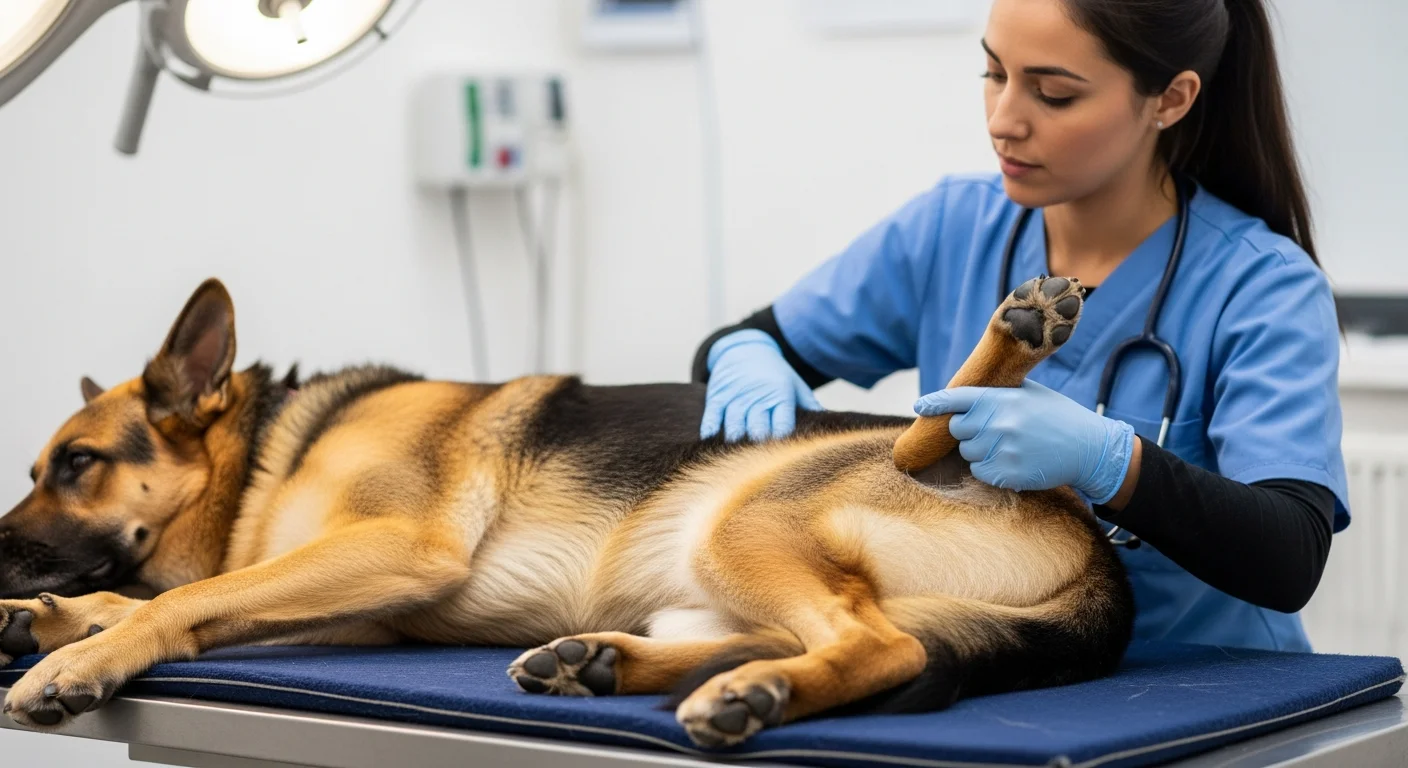
The earliest signs are subtle: mild hindquarter weakness, scuffing of the rear paws during walking, and difficulty rising from lying positions. Owners often attribute these changes to arthritis or normal aging, and indeed DM can be difficult to distinguish from orthopedic conditions in its early stages. Affected dogs may wear the nails of their rear paws unevenly due to dragging, a finding that should prompt further evaluation.
Stage 2: Progressive Paraparesis
Over weeks to months, hind limb weakness becomes more pronounced. Dogs begin to wobble when walking, cross their hind legs, and have difficulty with stairs or jumping. Proprioceptive deficits become obvious: the dog may not correct a paw that is placed knuckled-over. Urinary and fecal incontinence may develop as the disease involves the lower spinal cord segments.
Stage 3: Lower Motor Neuron Disease
The disease extends to involve the lower motor neurons of the hind limbs, producing flaccid paralysis and muscle atrophy. The hind legs lose virtually all function.
Stage 4: Generalized Disease
In dogs that survive long enough, DM can progress to involve the front legs and eventually the respiratory muscles, closely paralleling the terminal stages of ALS in humans. Most affected dogs are humanely euthanized before reaching this stage.
The average time from symptom onset to loss of hind limb function is approximately six to twelve months, though the range is wide and individual variation is significant.
Diagnosis
DM remains a diagnosis of exclusion during life. No blood test, imaging study, or electrodiagnostic test can definitively diagnose DM in a living dog. The diagnostic process typically involves:
- Ruling out intervertebral disc disease, lumbosacral stenosis, and other compressive myelopathies through MRI or CT
- Ruling out inflammatory, infectious, and neoplastic spinal cord diseases
- Confirming homozygous SOD1 mutation status through DNA testing
- Correlating the clinical presentation with the progressive, non-painful, upper-motor-neuron pattern expected in DM
Definitive diagnosis requires post-mortem histopathological examination of the spinal cord, which reveals characteristic axonal degeneration and demyelination in all funiculi, with predilection for the thoracic spinal cord segments.
Management and Supportive Care
There is no cure for DM and no treatment that halts its progression. However, several strategies can maintain quality of life and potentially slow functional decline:
Physical Rehabilitation

Intensive physical therapy, including swimming, assisted walking, and range-of-motion exercises, is the single most effective intervention for maintaining function. Studies have shown that dogs with DM that receive regular physiotherapy maintain ambulation significantly longer than untreated dogs. A structured rehabilitation program should begin as soon as DM is suspected.
Assistive Devices
Rear-support harnesses, wheelchairs, and protective boots can extend a dog’s active life. Many dogs adapt readily to wheeled carts and continue to enjoy a good quality of life for months after they can no longer walk independently.
Nutritional Support
While no diet has been proven to alter DM progression, antioxidant supplementation is often recommended based on the oxidative stress component of the disease. Vitamins E and C, coenzyme Q10, and alpha-lipoic acid are commonly used, though evidence of their efficacy in DM specifically remains limited.
Breeding Considerations
The high frequency of the SOD1 mutation in certain herding breeds presents a familiar challenge: eliminating the mutation entirely from breeding programs would unacceptably narrow genetic diversity. This is the same tension that breeders face with other prevalent genetic mutations in herding breeds, including MDR1 and Collie Eye Anomaly.
Recommended breeding strategies include:
- Test all breeding stock for SOD1 status before pairing
- Avoid A/A to A/A matings, which produce 100% at-risk offspring
- Prefer G/G to G/A or G/G to G/G matings where possible
- Permit G/A to G/A matings cautiously in breeds where the mutation frequency is so high that excluding all carriers would devastate the breeding pool, but select offspring for future breeding that are G/G or G/A
- Use the information alongside other health and diversity data, recognizing that DM risk is just one of many factors in a responsible breeding decision
In breeds like the Pembroke Welsh Corgi, where the mutation frequency is exceptionally high, a gradual reduction strategy over multiple generations is more prudent than aggressive selection against carriers. Understanding the inbreeding coefficient dynamics behind these high allele frequencies helps breeders contextualize the challenge. The population genetics principles governing allele frequency change also explain why gradual reduction is biologically more realistic than rapid elimination. For guidance on how to balance joint health screening alongside genetic testing in breeds prone to both DM and orthopedic issues, Hip Dysplasia in Shepherds provides valuable breed-specific resources.
Research Frontiers
DM’s similarity to human ALS makes it a focus of active research that benefits both species:
- Gene therapy trials using antisense oligonucleotides (ASOs) to reduce toxic SOD1 protein production are underway in dogs, building on approaches being tested in human ALS patients
- Biomarker development aims to identify blood-based markers that could diagnose DM during life, replacing the current reliance on exclusion diagnostics
- Modifier gene searches using genome-wide association studies are attempting to identify the additional genetic factors that determine penetrance
These research directions are part of the broader transformation in canine genomic medicine that promises more precise diagnostics and eventually therapeutic interventions for inherited neurological diseases.
Conclusion
Degenerative myelopathy is a devastating condition, but it is also one that breeders have the power to address through informed genetic testing and thoughtful breeding decisions. The SOD1 mutation test is widely available, affordable, and provides clear, actionable results. While the incomplete penetrance of DM means that genotype alone does not determine outcome, reducing the frequency of the at-risk genotype in breed populations is a straightforward and achievable goal.
For owners of dogs diagnosed with DM, early intervention with physical rehabilitation, assistive devices, and nutritional support can meaningfully extend quality of life. And for the research community, every dog with DM that participates in clinical trials or contributes tissue samples advances our understanding of motor neuron disease in ways that benefit dogs and humans alike.
For questions about SOD1 testing or DM management in your herding breed, contact our team for evidence-based guidance.